The Birmingham street lighting drone survey began as a two-week trial on a live city network and is now part of everyday delivery on the Birmingham Highways Maintenance Contract. Working with Kier and Birmingham City Council, HDS has surveyed 13,248 lighting columns from footways and verges, at 5.18 times the productivity of the traditional method and with 93.5% less CO₂ during survey operations.
In 2026 the project won the Innovation Award at the CECA Midlands Awards. This is how it got there.
At a glance
- 13,248 columns surveyed by drone for Kier and Birmingham City Council.
- 75.1 columns a shift against 14.5 by the traditional method.
- 93.5% less CO₂ during survey operations and zero accidents, injuries or near misses.
- Winner of the CECA Midlands Innovation Award 2026 and a CIHT Awards 2026 finalist.
The problem with inspecting a lighting column
Kier is the main contractor on the Birmingham Highways Maintenance Contract, maintaining more than 92,000 streetlights for Birmingham City Council. Inspecting a column the traditional way means an impact protection vehicle, a MEWP, a 3.5 tonne dropside, traffic management and an operative working at height beside moving traffic. A crew would typically manage 15 to 30 columns a shift, and the paper checklists that came back were too subjective to support long-term planning.
The risk is real. IPAF data covering ten years on roads and highways records 37 fatalities and 4 major injuries from falls from the platform, and 20 fatalities and 15 major injuries from MEWP strikes involving passing vehicles or site plant. Traditional lighting inspection sits inside both risk groups.
How the Birmingham street lighting drone survey began
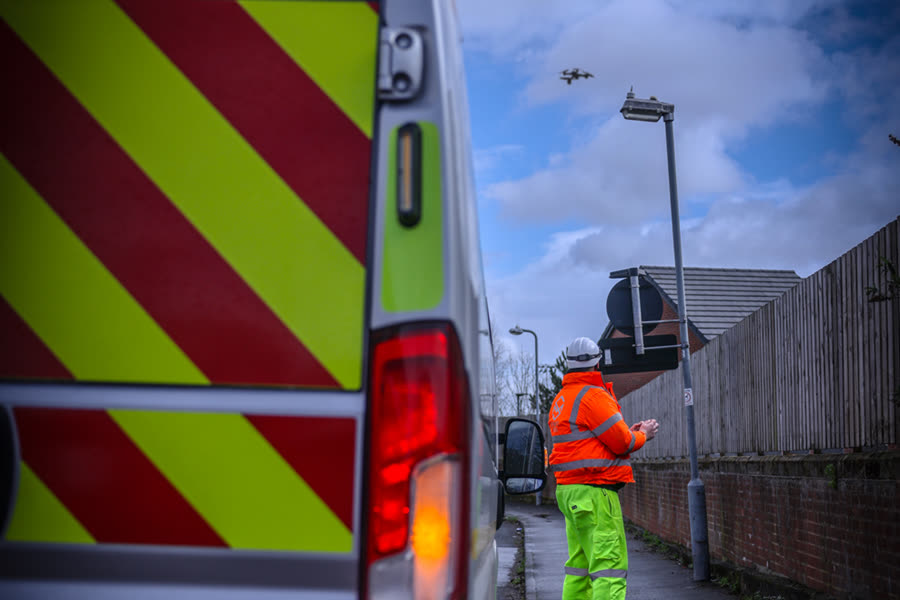
Kier gave HDS the chance to prove an alternative: one Peugeot Boxer and one drone system, flown from the footway, against the IPV, MEWP and dropside set-up.
- 751 columns inspected by drone, an average of 75 a day
- 145 columns by the traditional method in the same period, 14.5 a day
- More than five times the output, with no one at height and no one in the carriageway
- 86% less CO₂ across the trial: 122.94 kg against 874 kg
From trial to business as usual
The trial gave a clear business case and the method moved into normal delivery on the contract. The figures held up as the programme grew:
| Stage | Columns | What the numbers showed |
|---|---|---|
| Two-week trial | 751 | 75 a day against 14.5, and 86% less CO₂ |
| Early rollout | 7,137 | 65 a day on average, with no accidents or near misses |
| Scaled programme | 9,000+ | Around 2,800 crew hours saved and total cost down about 60% |
| Programme to date | 13,248 | 5.18 times the productivity and 93.5% less survey CO₂ |
Across the full rollout, the project figures show around 234 tonnes of CO₂ avoided, an 81% shorter programme and 738 fewer days occupying the public network.
A better record, not just a faster one
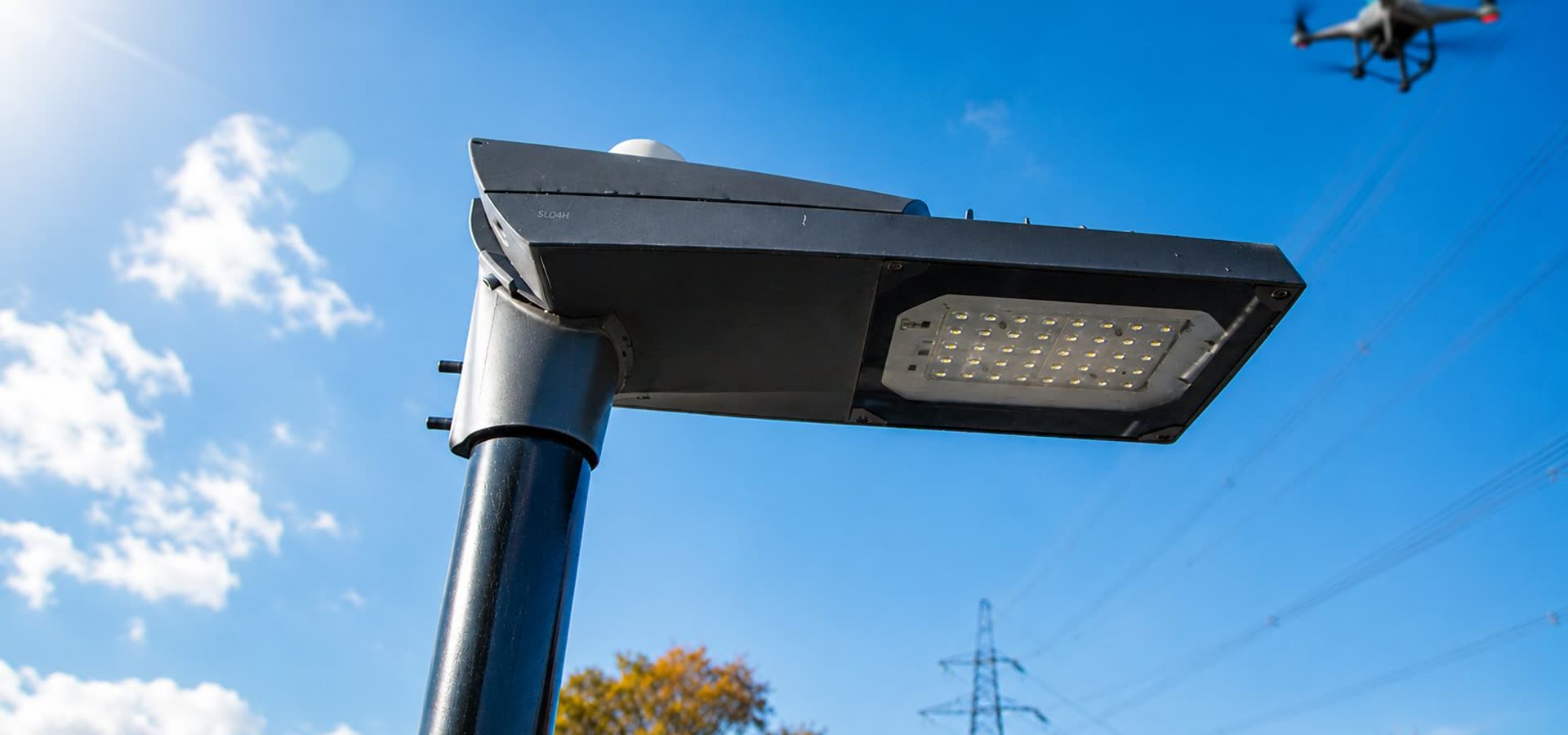
Speed was the headline, but the bigger change was the data. Every column is captured as a geo-tagged, condition-scored record and loaded into the council’s GIS instead of being written up on a checklist. So far the survey has logged 3,574 OSID nodes, 900 telecell timers, 424 photocells, 520 missing or damaged stickers and 232 heritage lanterns.
Pilots work from footways and verges with a Chapter 8 compliant mobile base, with no lane closures and no IPV.
The recognition
- Highly Commended: Best Use of New Technology, Highways Awards 2025
- Highly Commended: HEA and HEMSA Safety Initiative, HEA Awards
- Finalist: Technology and Digital Transformation, CIHT Awards 2026
- Winner: Innovation Award, CECA Midlands Awards 2026
After the CECA win, Marc Hobbins, Director of Highways Drone Services, said:
“Kier gave us the opportunity to demonstrate what the technology could do in a real highways environment. More importantly, they worked with us to develop the approach and have taken it from an initial trial into business-as-usual delivery.”
Ian Davies, General Manager at Kier Infrastructure, pointed to the benefit for residents:
“Using HDS allowed us to remove traffic management and road closures from many inspections, reducing disruption, noise and impact on local communities.”
What other lighting authorities can take from it
The drone was not the hard part. Three things made Birmingham work:
- A contractor willing to trial it on a live network. Kier coordinated operations and aligned the trial with existing processes.
- A client willing to back it. Birmingham City Council supported the trial on live streets and helped test the method in everyday conditions.
- Data built for the client’s system. Records designed to go straight into the asset system rather than sit beside it.
The same workflow is now extending to bridges, high-mast signage, drainage and retaining walls. Read the full Birmingham case study, our guide to drone street lighting inspection, or the details of our lighting and high mast inspections.
Frequently asked questions
How many columns can a drone inspect in a day?
In the Birmingham trial the drone method averaged 75 columns a day against 14.5 for the MEWP-led set-up. Across the programme the figure is 75.1 columns a shift, 5.18 times the traditional output.
Do the drones fly over the road?
No. Pilots work from footways and verges and never fly over live traffic. That is what removed the need for lane closures and impact protection vehicles on the Birmingham contract.
What does the council receive from the survey?
Every column is captured as a geo-tagged, condition-scored record that is loaded into the client’s GIS, including details such as OSID nodes, telecell timers, photocells and missing or damaged stickers.
Has the Birmingham project won any awards?
Yes. It won the Innovation Award at the CECA Midlands Awards 2026, was a finalist at the CIHT Awards 2026 and received Highly Commended at the Highways Awards 2025 and the HEA Awards.
Running a lighting inspection programme? Ask us about a trial on your network.