Traditional highway surveys are notoriously time-consuming, but not because of the inspection itself. They take time because access drives the programme.
When you rely on physical access, your schedule is dictated by lane closures, safety constraints, and traffic management (TM). Crews, vehicles, and rolling blocks limit how much work can be completed in a single shift.
Drones change the paradigm by removing physical access from the equation entirely. Here is how switching to UAV (Unmanned Aerial Vehicle) technology turns a ten-day struggle into a two-day success.
The Bottleneck: The Traditional Survey Model
A typical lighting or asset survey has traditionally relied on vehicle-based access and manual inspection. To inspect a lighting column or bridge joint, you typically need:
- Heavy Logistics: An Impact Protection Vehicle (IPV) on-site all day.
- Access Equipment: A MEWP (Mobile Elevating Work Platform) or similar platform.
- Risk: Multiple operatives working directly in live traffic.
- Disruption: Lane closures or rolling blocks that frustrate the public.
The Output Ceiling
In real terms, these logistical hurdles limit daily output. On many highway schemes, manual methods average roughly 250 to 300 lighting columns per day. Productivity drops even further where traffic flows are high, or access windows are restricted to short night shifts.
Why Traditional Surveys Drag On
The delay is rarely caused by the surveyor. The delay is caused by the environment.
A five-to-ten-day programme is common for medium-sized asset surveys because of:
- Setup Time: Traffic management installation and removal.
- Repositioning: The slow movement of heavy plant machinery between assets.
- Safety Protocols: Mandatory briefings and live traffic controls.
- External Factors: Abortive visits due to unforeseen congestion or adverse weather.
The Solution: Decoupling Access from Inspection
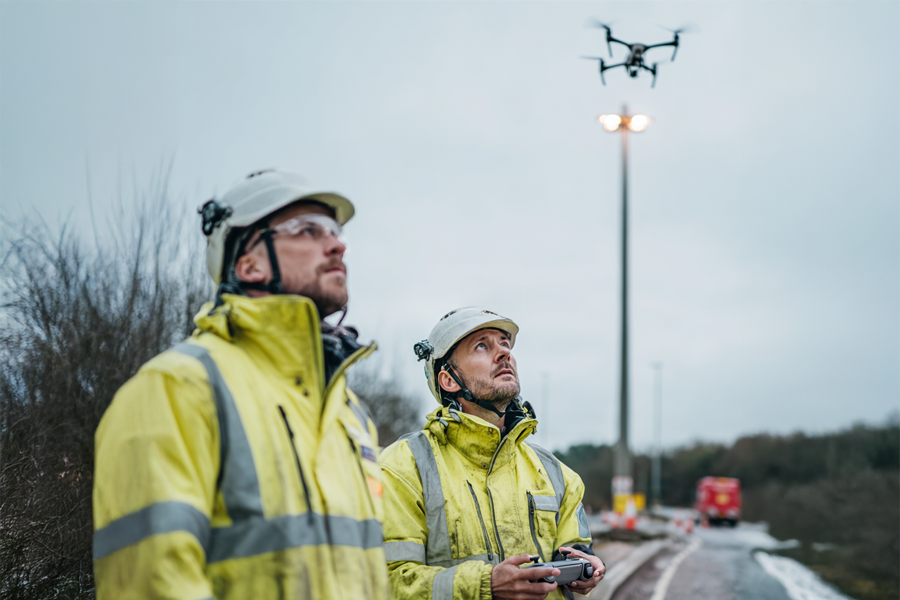
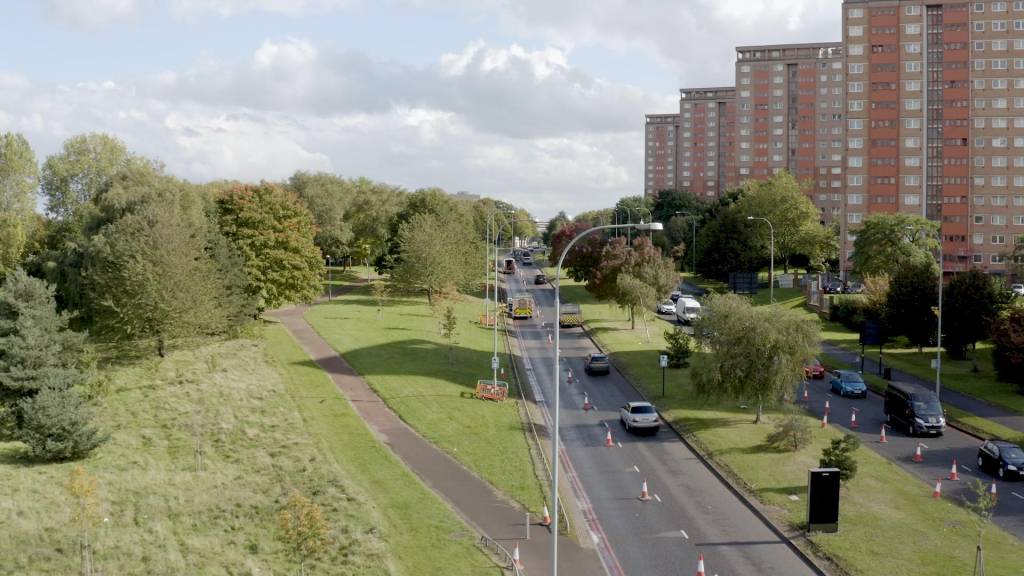
Drone surveys eliminate the majority of these physical constraints. By utilizing a small, mobile team, surveys are conducted from safe locations off-network, without ever entering the live carriageway.
A typical drone workflow replaces “stop-start” plant movements with:
- Rapid Setup: Short pre-flight checks from a safe vantage point.
- Continuous Capture: Pre-planned flight paths that glide over obstacles.
- Non-Intrusive Access: High-resolution image capture from above without closing lanes.
Case Study: Real-World Output Comparison
The difference in efficiency is measurable. During a recent lighting survey, HDS compared drone capabilities against traditional benchmarks over the same period.
| Metric | Traditional Method | Drone Method |
| Daily Output | ~300 Columns | 751 Columns |
| Team Size | Multiple Operatives + TM Crew | Single Drone Team |
| Equipment | MEWP, IPV, TM Vehicles | Support Vehicle + Drone |
| Road Impact | Lane Closures Required | Zero Lane Closures |
The Result: The drone team completed the capture in just two days. Under a traditional setup, capturing the same volume would typically require up to ten working days once logistics and downtime were factored in.
Speed Without Loss of Detail
Speed is irrelevant if the data quality suffers. However, modern drone optics often outperform manual visual checks.1
Drone capture provides:
- High-Resolution Records: 4K/high-megapixel visual records of every asset.
- Consistency: Standardized inspection angles that remove human subjectivity.
- Digital Twins: Repeatable datasets that allow for year-on-year change detection.
- Auditability: Digital records that can be reviewed off-site by multiple engineers.
Safety and Cost: The Bottom Line
Reducing time on site delivers a direct safety dividend. By removing the need for MEWPs and IPVs, drone surveys significantly reduce:
- Live traffic exposure (boots on the ground).
- Working at height risks.
- Plant movements in congested areas.
Naturally, cost control follows. Fewer vehicles, fewer operatives, shorter programmes, and the elimination of expensive traffic management creates a drastically lower cost per asset.
Summary
The “ten days to two days” reduction is not magic; it is simply the result of removing the biggest obstacle in hig